


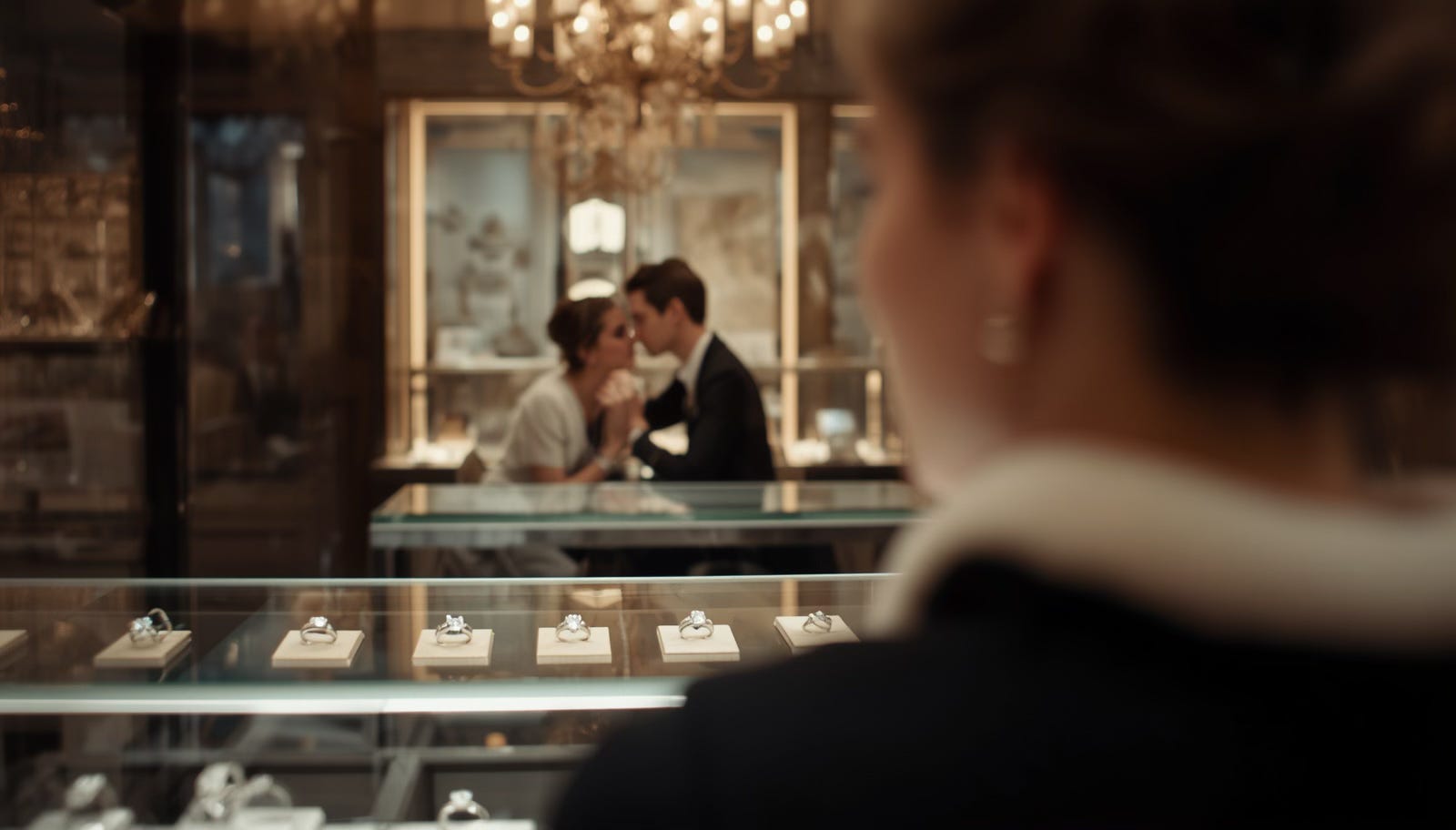
Not every engagement ring appointment felt like work.
Some guests walked in and immediately made the room feel light, the kind of energy that made me want to actually engage in the conversation rather than simply facilitate it.
One couple in particular comes to mind. Neither was dragging the other there. Neither was performing enthusiasm they didn’t have. They genuinely wanted to shop together.
He paid attention to what styles she gravitated toward. She was thoughtful enough to make it clear she wasn’t trying to take advantage of his budget. They asked questions, shared stories, laughed at each other’s jokes, and somewhere in the middle of it, the conversation drifted.
She looked up at me and said, “You must know what ring you want after working in a jewelry store.”
He jokingly followed up shortly after. “Yeah, your future husband is going to have a very high standard to live up to. Good luck to his pockets.”
I smiled and redirected the focus back toward them to keep us on track. I learned early on that discussing my own complications with marriage in the middle of someone else's proposal story is a reliable way to kill the mood.
But those comments lingered.
The first time a client asked me what I wanted for my engagement ring, I didn't have an answer. I hadn’t even considered it. I was in college, working my first 9-to-5 job, and marriage felt like something reserved for adults who had life more figured out than I did. I hadn’t grown up around many examples of it, so I never romanticized it how girls my age did.
I stumbled into fine jewelry consulting expecting to learn about diamonds. Instead, I found myself studying the people buying them.
An engagement ring appointment compresses an incredible amount of a relationship into a short conversation. Love, money, family expectations, insecurity, generosity, compromise, status, fear, and excitement collide all at once. As a Sociology major, I couldn’t have imagined a better place to my degree to use.
Every couple became a case study where I learned how much thought, effort, and emotion people pour into preparing for marriage. The traditions, the ceremony, and the financial and emotional investment that come with choosing your "forever person." I also watched engagements outlast the marriages they were meant to begin.
The clients shopping for a second and third ring taught me the harsh realities of marriage, which, in turn, made me most hesitant. There’s nothing wrong with trying again, but many of them told me that they had been absolutely certain the first time. That the person they were marrying was the one until life proved otherwise.
That kind of certainty followed by revision is not a realization you can unknow.
I also assisted couples who made me wonder why they were there at all. They never seemed unhappy, but nothing between them felt chosen. The conversations felt rehearsed. The energy was flat in a way that had nothing to do with nerves. It seemed less like a decision and more like two people arriving at the next stop on a route neither of them questioned.
I used to think long relationships automatically meant certainty. Working in jewelry taught me they were often much more complicated. Sometimes, people stay together because they still choose each other. Sometimes they stay together because neither knows what else to do.
But then there were couples like the one in the opening scene.
Those were the ones that gave me hope.
They weren’t a blueprint for what my relationship should look like. They were a reminder that commitment can feel intentional rather than inevitable.
Over the years, clients shared advice with me the way people do when they discovered I was younger than expected. Strangers would tell me lessons from decades of relationships during my forty-five minute sales presentation.
Most of it came down to this: know what you want and why you want it.
Looking back, that was the thread connecting nearly every couple I met, whether their marriage lasted or not. The individuals going through the motions often hadn’t stopped to ask themselves why they were getting married. The partners trying again had usually been forced to ask the question after their first marriage ended.
Even the happiest relationships weren’t guaranteed a different outcome. Plenty had once been just as certain before life challenged them. What separates them wasn’t whether they got it right the first time. It was whether they understood what they were choosing and why.
The outcome was never entirely in their control. Though, their intention was.
I’m more at peace with the uncertainty now than I used to be. I want to get married one day, to the right person, once. I’m willing to do it once. But I also know marriage is not the ceiling of a life well-lived.
My perspective on marriage changed long before I decided what I wanted on my ring finger. And when clients asked me what I wanted, I noticed the answer wasn’t really about taste. It was about everything I believed marriage represented.
I want a natural diamond. Preferably a setting that’s unusual, not what’s currently trending. A ring that makes someone pause and say, “Okay… as long as you love it.” I’ve always been drawn to unique pieces, because they feel more like an extension of the person wearing them than a traditional style.
I remember the controversy around Abby Bucco’s “can opener” engagement ring. While the internet called it hideous, I couldn’t stop thinking about how refreshing it was. The reaction fascinated me because, people weren’t just reacting to the design. They were reacting to their own idea of what an engagement ring was supposed to be.
She chose a piece that was unmistakably hers and had a sense of identity that made it memorable.
Honestly, I might end up wanting more than one engagement ring as well. Not because I can’t commit, or at least not only because of that, but because jewelry has always been a rotating part of how I express myself. The idea of wearing the exact same ring forever doesn’t completely align with how I think about jewelry as a form of expression. I like the idea of selecting the one that feels right in the moment, which is really just the same belief in a smaller form: that meaning comes from an active choice, not a permanent object.
Whether that preference comes from self-expression or a subtle resistance to permanence, I’m honest enough to admit it might be both.
My preference for natural diamonds may be a product of the very mythology I’ve spent Part 1 and Part 2 examining. Social signaling, the desire to be chosen publicly, and the standards inherited from generations before me. I’ve written about all of it as though I’m standing outside of it, but I’m not. My taste is shaped by the same culture I am questioning. And I still want a natural diamond.
Those things can exist at the same time.
Awareness doesn’t always erase desire. Sometimes it simply helps you understand where that desire came from.
What makes engagement rings feel different to me is the specific weight of the symbol. For a long time, couples who wanted an alternative chose something categorically different, like sapphires, rubies, or other gemstones. Diamond simulants, such as moissanite and cubic zirconia, never created the same tension because they were understood as different products altogether.
Lab-grown diamonds changed the conversation by making the alternative visually indistinguishable from the original. They ask us to believe the meaning stays intact even as the underlying assumptions shift.
I’ve watched the lab-grown debate get framed as a question of ethics, budget, or personal taste. And it is all of those things. However, beneath that is a much older question about sacrifice.
What are we willing to sacrifice for the things that matter to us?
Choosing a lab-grown diamond isn’t inherently less thoughtful. For some couples, putting that money toward a home, paying off debt, or building their future together may be the more intentional expression of commitment.
Not because spending more automatically creates love. Not because a natural diamond is proof of anything a lab-grown diamond isn’t.
But because sacrifice consistently has been one of the ways society recognizes significance. The cost becomes part of the sentiment it carries. I thought about this every time a couple chose a lab-grown stone so they could put more toward a down payment, or chose natural because the cost itself felt like the point. Neither one was less serious about what they were building.
Lab-grown diamonds didn’t introduce a new product. They introduced a new relationship with sacrifice. Calling that progress or loss depends on what you believe sacrifice is meant to represent in the first place.
For me, natural diamonds preserve an aspect of that symbolism I still find valuable.
I didn’t realize that the question my clients were asking me would take years to answer.
Maybe that’s because I no longer think it has a single right answer.
What I care about now is understanding the values behind my own desires before deciding whether they’re worth defending.
I don’t think luxury is about owning expensive things. I think it’s about choosing your symbols deliberately. Luxury, at its best, isn’t permission to consume more. It’s an invitation to become more conscious of what you allow to represent your life.
That’s my answer today.