


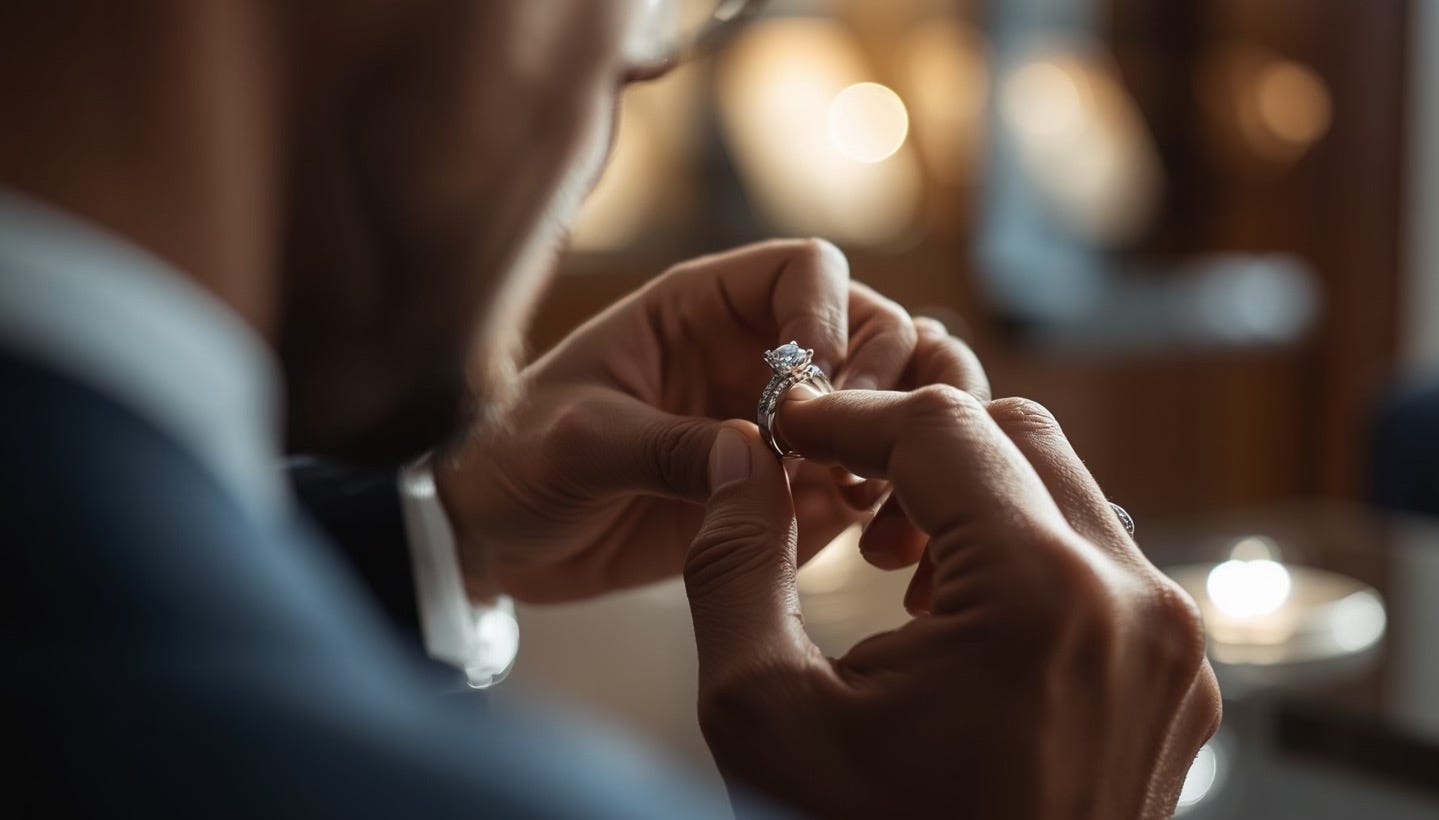
The man who stood across the showcase from me couldn’t say what diamond shape his girlfriend liked. He couldn’t tell me what jewelry she wore. He couldn’t even tell me what her favorite color was, leaving me with nothing but the thought: how do you buy something this significant for someone you barely seem to know?
We made it around the showroom, settled on a style, and finally talked price.
He quickly realized that the natural diamond engagement ring we were considering cost more than he was expecting.
“Well, what’s this I heard about lab-grown diamonds? Can I see one?” I already saw where this was going, but I played along.
Suddenly his face lit up for the first time since he walked in. Better quality, bigger stone, less expensive.
Box it up.
“What she doesn’t know won’t hurt her.”
Cue the cringe.
I’ve heard variations of that sentence during my years of selling engagement rings. It wasn’t always malicious. But it was consistent.
Most of the time, it appeared when a woman had no clearly stated preference and the decision was left entirely to him. Once lab-grown diamonds went mainstream, men suddenly had a new option: a stone that looked just as natural to the average eye while costing significantly less. For some, that simply meant more flexibility. For others, it seemed to create a temptation to make the decision on her behalf.
What bothered me wasn’t the choice itself. It was the assumption that a preference only mattered if it had been explicitly stated. If she hadn’t asked for a natural diamond, then a lab-grown one would suffice. And because a diamond is a diamond, she didn’t need to know the difference.
I always encouraged clients to discuss natural versus lab-grown diamonds before shopping, or at the very least disclose the choice afterward. Yet I still met women who came into the store after a proposal, asking me to confirm whether the diamond on their finger was actually what they’d been told it was.
Those situations undoubtedly existed before lab-grown diamonds. But as they grew in popularity, I noticed it happening more often.
It also brought attention to a larger shift taking place in the engagement ring industry. Not just in what people were buying, but their approach to the purchase and the language used to justify it. Lab-grown diamonds are labeled as the ethical, sustainable, conflict-free alternative. And that justification indirectly gave women a socially acceptable way to expect less, and gave men a socially acceptable way to spend less.
After enough time on the sales floor, the pattern got hard to ignore.
If a woman was adamant about a natural diamond, the conversation went differently. Her preferences were known. On top of that, I noticed that the man usually knew more about her and all the details that signal how closely someone has actually been paying attention.
But when a woman was described as easygoing, the outcome was often the same. She got a lab-grown diamond.
It wasn’t about the diamond itself. It was about how often the decision fell on the man’s interests rather than hers. The moment lab-grown diamonds entered the scene, a lot of men stopped shopping for the woman they were proposing to and started shopping for themselves.
Men with girlfriends who preferred natural diamonds would say things like, “She’d kill me if I didn’t get her a natural diamond.” There was an acknowledgment that her standards existed and mattered.
The language around the women who ended up with a lab-grown was more like, “She doesn’t care either way, and I’m not complaining.”
My point is that the clearer a woman’s desires were, the more likely they were to guide the purchase. The more vague or accommodating she was, the easier it became for someone else to decide for her.
Now, the idea that you have to tell a man what you want isn’t groundbreaking information. But watching this interaction play out over and over again in this context definitely reiterates how important it is to know and communicate your preferences.
In all fairness, the men’s involvement was more complicated than my observation highlights.
Most of them weren’t trying to get away with something. They were actually more nervous than I’d ever seen a grown man be. The engagement ring process genuinely intimidated them. They were afraid of choosing wrong, disappointing someone they loved, spending too much, spending too little.
The ones who seemed most at ease had one thing in common: they knew exactly what she wanted.
When a man could communicate his girlfriend’s preferences, he was more confident because he wasn’t negotiating against an invisible standard. And when he had a direction, he was even willing to spend more.
I remember conversations where a man found out that the lab-grown diamond his girlfriend specifically wanted cost far less than he’d expected, and instead of quietly keeping the difference, he started thinking of ways to use it. A bigger stone, an upgraded setting, a hidden halo, an engraving, anything.
“She’s worth it,” he’d say.
For those men, the goal was never to be cheap. It was to make her feel like he’d really thought about it.
That’s where the pattern started to break down.
The pattern I kept seeing, lab-grown allowing men to sacrifice less while still looking generous, was real. But it was most true for men whose girlfriends’ desires had become vague enough to be negotiated downward. The men who actually knew their partners often behaved differently.
Either way, there was something nearly every one of them wanted.
To feel like a hero.
Sometimes they said it outright: “If I get this ring, I’ll look like a superhero.”
I was guilty of using that line myself. At 23, standing behind a glass case, I had a strange kind of access to a grown man’s confidence about his own relationship. There’s an odd amount of power in that position. Someone’s entire sense of themselves as a partner is briefly sitting in my hands, and my manager just wants me to close the deal.
The crazy part about it was that line always worked. I simply mirrored the version of himself he was already hoping to see, and he bought the ring. Every time.
I told myself in those moments that there was a difference between manipulation and confirmation. I’m still not entirely sure how well that holds up.
What lab-grown diamonds did was make that superhero moment more accessible. A man could walk in nervous, walk out with a bigger stone than he expected at a price he could actually manage, and feel like he had delivered.
The feeling of generosity, at a discount.
Whether that counts as progress is something I’m still thinking about.