


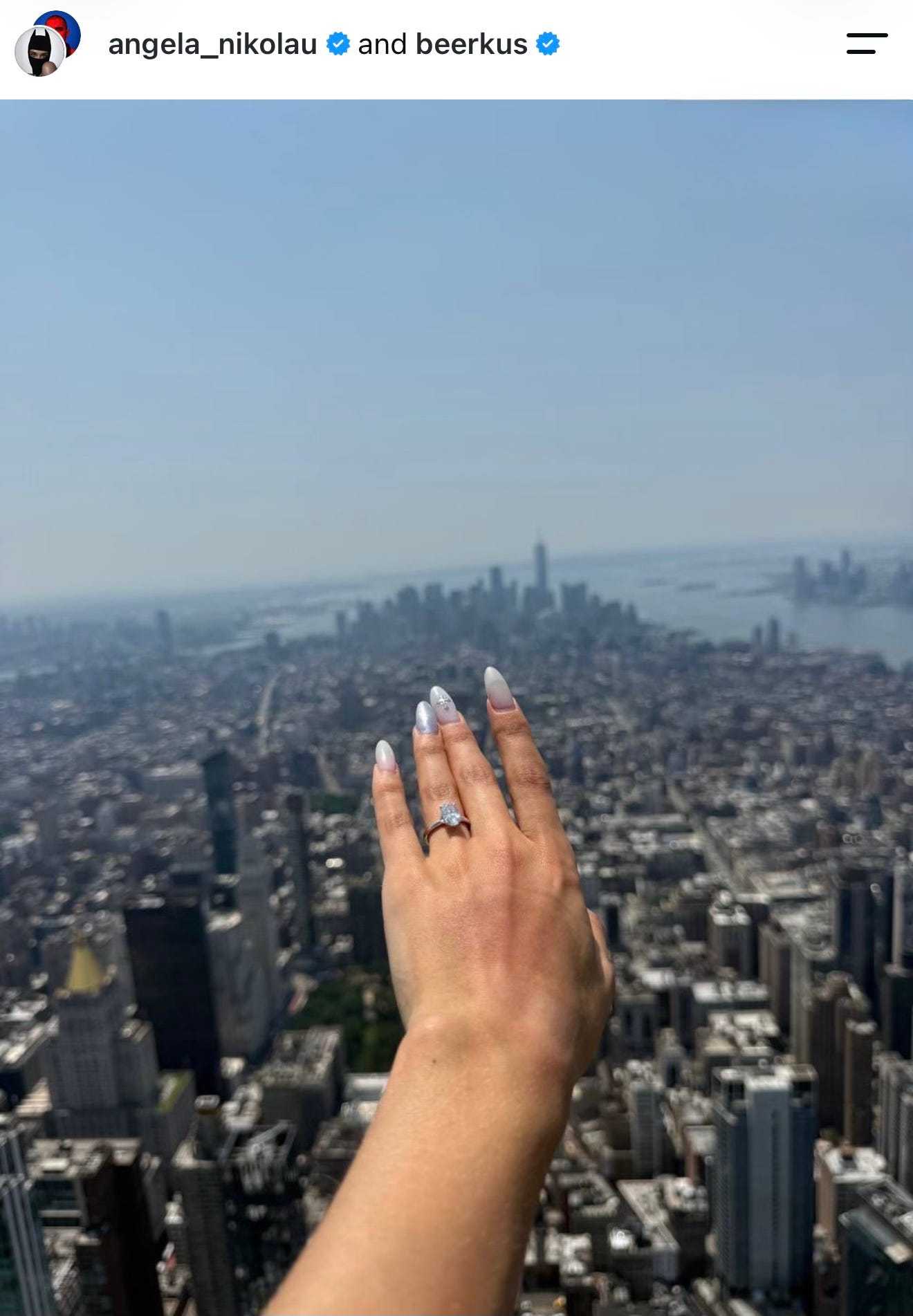
The Empire State Building proposal wasn’t just an extraordinary display of romance. It turned one of society’s oldest symbols of commitment into a political statement.
When Angela Nikolau and Ivan Beerkus, who appear in Netflix’s Skywalkers, reached the top of the building to get engaged, most people rightfully couldn’t get past how wild it was. Scaling one of New York City’s most recognizable landmarks without permission is an act of civil disobedience. The danger, the risk of arrest, the sheer audacity of it all. It was easy to write off as another viral stunt.
But I think that misses what made the moment so compelling.
Behind the couple hung a flag reading: “When the power of love beats the love of power, the world will know peace.” The proposal became the perfect expression of that message, giving the protest an almost cinematic feel. An intimate symbol turned into a declaration about the kind of world passion can build.
An engagement ring has always meant more than a diamond. It represents choosing one person, imagining a shared future, making a promise that outlasts the moment it’s given. Placed inside an act of protest, though, the ring starts to say something bigger. It becomes evidence that love itself can be a form of resistance.
The Ring’s Quiet Resistance
The ring’s design reinforces that idea in quiet ways. Designed by jeweler Nuno Rocha, also known as Diamondboi, it features an oval-cut natural diamond set in a classic 18-karat white gold solitaire with a hidden halo. It isn’t excessive. It isn’t attention-seeking. Against one of the boldest proposals possible, it’s remarkably restrained.
In a ring landscape increasingly obsessed with oversized, hyper-colorless stones chasing maximum visual impact, that simplicity feels almost radical. Intentional or not, it reads like its own quiet protest, a reminder that meaning has never depended solely on size.
But the detail that stayed with me was the engraving.
Engravings traditionally live hidden inside the band, meant only for the wearer. However, the phrase “Your full potential is on the other side of fear” is engraved on the outside for the world to see. A nice bit of wordplay, given its placement. That single choice changes everything the ring communicates. An outside engraving is a public statement, illustrating the proposal itself. The fear isn’t quietly overcome behind closed doors. It’s acknowledged out loud, in daylight, 1,400 feet above the city.
Considering the circumstances of the proposal, the phrase feels almost inseparable from the act itself.
Jewelry has carried this kind of quiet defiance before. Rings, lockets and brooches have long been a way to carry hidden texts for affection, grief, or loyalty when saying it out loud wasn’t really an option. This ring belongs to that lineage, except it flips the script. Instead of hiding its message, it wears it in plain sight.
Commitment Was Always a Risk
Reaching the top of one of New York’s tallest buildings took physical endurance, legal risk, and a willingness to accept real consequences. Isn’t that also what commitment requires?
No lasting relationship exists without risk. Choosing one person means giving up every other possibility. It demands vulnerability, trust, and the intention to build a future with no guarantees attached. Love has never been the absence of fear. It’s the decision to move through it with someone else, without a safety net.
Maybe that’s why this moment resonated with me. It reminded me that it isn’t valuable because it’s safe. It’s valuable because, despite everything at stake, we choose it anyway.
This doesn’t just apply romantically. Love extends into how we protect, defend, and show up for each other as a society. Without that compassion, peace remains out of reach.
The couple gambled on themselves, but also for all of us watching. A reminder that this kind of commitment only holds real weight when we’re willing to risk something for someone beyond ourselves.
Beyond Carat Weight
What I appreciate most about this moment is how it widened the conversation around what romance and fine jewelry can represent. Too often we reduce proposals to carat weight, venue, and budget, as if the ring’s only job is to impress. This one redirected attention toward something older: the idea that love can be a force that challenges fear, ego, and even power itself.
Ironically, the internet moved on fast. The flag became a template for AI-edited reposts pushing brands, products, and unrelated agendas. Creative reinterpretation online is inevitable, but I wish we’d sat with the original sentiment a little longer. Not every cultural moment needs to become marketing. Some deserve to stay as conversations.
Angela and Ivan stood above the city under a banner calling for peace, asking us to think differently about commitment. The ring wasn’t just documenting a relationship. It became part of the protest’s language, proof that love is capable of more than we allow ourselves to imagine.
Maybe that’s the real achievement of the stunt. It reveals that peace doesn’t only come through grand political gestures. Sometimes it starts with two people choosing each other, believing that uniting is still powerful enough to be worth risking everything for.