


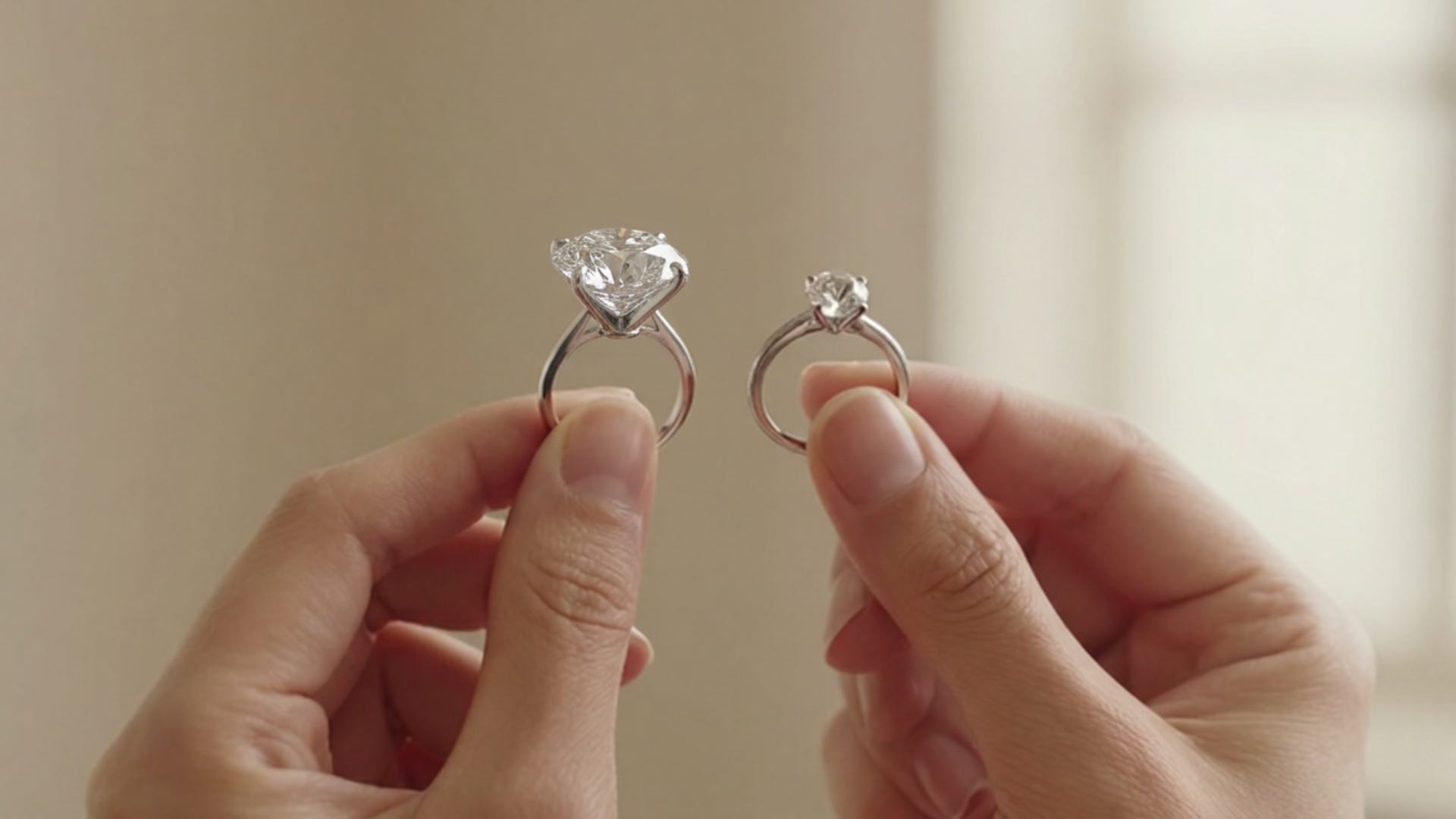
Sunny days working at the jewelry store meant two things: walk-in traffic would be slow, and the little we did get would be future fiancées on a mission.
A woman and her best friend, browsing engagement rings because her boyfriend was “showing signs.” They came in a little dressed up, enough to read as intentional, but never obvious enough to admit it. I never needed them to say why they were there, though. I always knew.
After two glasses of champagne, we went through the cases together. She tried rings on while her friend chimed in from a few feet away. Too plain, too gaudy, “wait, go back to that other one.” Some of what she thought she wanted looked different on her ring finger than it had on her Pinterest board. Some styles she hadn’t even considered looked better than she’d expected.
We eventually got to the lab-grown cases.
She browsed for a moment, mentally comparing the stone sizes. Then, almost exactly the way it always happened, she tilted her left hand toward the light and asked the question.
“Would anyone be able to tell?”
At first, I thought women were asking if the diamond looked real. The longer I spent behind the counter, the more I realized they were asking something much deeper, something that had little to do with my gemological training and everything to do with symbolism.
In Part One, I wrote about how the emergence of lab-grown diamonds changed men’s approach to purchasing engagement rings. Most of them wanted to compare its characteristics to the price. “So what’s really the difference?”, was another way of asking whether the premium for a natural diamond was worth paying. They were really asking about economic value.
Occasionally men asked the same question women did, but it was about whether anyone would notice he’d spent less. Even then, the question was really about cost, dressed up as concern about appearances.
Women usually asked about social meaning instead.
What makes lab-grown diamonds so complicated is that they’re not just another gemstone option. They’re visibly and chemically identical to a natural diamond, allowing them to carry the same social meaning while costing a fraction of the price.
Nobody actually believes the size of a stone is a perfect measure of love. However, symbols don’t get their power from logic. They get their power from collective belief. And lab-grown diamonds figured out how to borrow that belief without paying what it used to cost.
Lab-grown diamonds didn’t rid us of the social expectations around engagement rings. They simply made them cheaper to satisfy.
Which should have disrupted the status signal entirely.
Instead, it preserved it at a discount.
Women weren’t shopping for a financial asset the way men were. They were shopping for a social one. The feeling of being chosen, publicly, by someone willing to demonstrate it. It’s rarely just about the ring. It’s about the story the ring tells on her behalf, and how that story signals the right message once it leaves the showroom.
That last part matters more than people admit. A woman who gets engaged wears the evidence of it daily, in front of people who will judge it whether she invites them to or not. The immediate unspoken validation, “He must really love you.” Followed by the quick subconscious calculation of how much.
The size of the stone, the quality, the cut, all of it becomes shorthand for how much a person is valued, which then gets translated into status. That interpretation might be reductive. It might be exactly the kind of thing we should have evolved from by now. And yet it persists, because the people forming their judgements aren’t making a deliberate intention to be unkind. They’re just doing what people have always done with symbols, reading what it signifies.
Which is exactly why I see that question as a double-edged sword. She wasn’t really asking me. She was asking me as a proxy for every room she was about to walk into for the rest of her life if she chose a lab-grown diamond. She was trying to access the social status a larger diamond signals, while questioning if it would be received as genuine.
Ironically, that’s exactly why so many women choose lab-grown diamonds in the first place. They believe a larger stone elevates how they’ll be perceived, when in reality they’re still measuring themselves against someone else’s definition of status. The appearance changes, but the hierarchy they’re trying to climb remains exactly the same.
What I found most interesting wasn’t the choice itself, but the moment that choice shifted.
There’s a specific point in that conversation, and I watched it happen enough times to recognize it, where a woman stops shopping for herself and starts shopping for the room she’s in. Where the internal question “what do I actually want?” suddenly gets replaced with “what will this say about me?” Not out of dishonesty, but out of the very human instinct to want this romantic symbol of commitment to balance authenticity and aspiration.
The friend’s role in moments like that shows that “the room” wasn’t always some distant, hypothetical audience. Sometimes she was standing two feet away, watching the future fiancée try on a version of herself she hadn’t considered before. At times, the friend would openly say that a huge lab-grown diamond didn’t feel like her, based on everything she’d shared in the past. Other times, the response was quieter. A look only I seemed to catch where her eyebrows spelled, Really?. And sometimes the friend asked the question on her friend’s behalf, using the moment as a rehearsal for a decision she hadn’t yet had to make herself.
It’s not a weakness. It’s what happens when the social meaning of an object becomes so loaded that it starts to compete with your own relationship to it.
I thought about that question long after those women left the store, because it was one of the most common things I heard as a consultant. “Would anyone be able to tell?” is only worth asking if you’re planning to let people interpret your ring as something it isn’t. What bothered me wasn’t the lab-grown diamond. It was the impulse to pass it off as something other than what it is.
The reason people want a larger, more impressive lab-grown stone is still measured against natural diamond value. Lab-grown didn’t disrupt that standard. It found a way to approximate it for less, which is perfectly fine. However, choosing lab-grown and then hoping no one can tell isn’t opting out of the old system. It’s trying to hack it.
The question doesn’t always end when she leaves the store, either. Some women came back after a proposal for a resizing and asked me, half-joking, if I could tell. I technically can’t. But I’ve been trained to make an educated guess, and I think some part of them already suspected that.
I also noticed the same women who quietly hoped no one could tell were often the ones with a justification already prepared, as if the choice had nothing to do with how it would be perceived. Maybe for some of them it didn’t. But for a lot of them, the explanation arrived a little too rehearsed to be only about ethics, sustainability, and practicality.
Over time, I’ve realized that the question doesn’t go away after I answer it. It just goes quiet, then resurfaces in more casual ways. Sometimes it shows up in comment sections online, where women defend lab-grown diamonds that often sounds less like a settled conviction and more like an argument they’re still having with themselves. That’s not proof their preference was wrong. It’s proof the question is more deeply nuanced than any answer could solve.
Here’s what I noticed about the women who didn’t ask that question at all.
The ones who chose lab-grown confidently, on their own terms, didn’t need to. They were forthright about it from the start. They didn’t care to see natural diamonds at all. They’d already done their research and arrived knowing exactly what they wanted, which, again, was the difference that kept showing up across every version of this conversation.
They also didn’t push for the biggest stone the budget could technically reach. Several stayed at a size that suited her hand, personality, and lifestyle rather than maximizing for impact. They chose modestly, on purpose.
Compare that to the women who would trade in a natural diamond they already owned for a bigger lab-grown one. Economically, that trade makes no sense at all. You’d be giving up real, market value for the appearance of more. But it makes complete sense if what you’re actually optimizing for isn’t the diamond. It’s the size of the statement.
That’s the clearest indication I have that this was never really about the stone.
Knowing what you want is only half of it, though. The harder, unadvertised part is knowing why you want it.
Nobody in a jewelry store is going to ask her why. Consultants want a sale, not a self-aware customer. So if that work happens at all, it happens before an appointment is set. Not just researching what’s out there, but being honest with herself about why a certain decision feels necessary. If the desire is coming from her own taste, or from something she’s absorbed so completely she’s stopped noticing it isn’t entirely hers.
I don’t know what steps it takes to get there. I only know what it looks like from behind a glass showcase when someone already has.
Whether the choice is natural or lab-grown, it should be made for the right reasons. It should reflect what she genuinely values, not because it performs a version of the ideals she believes she’s supposed to embody. A lab-grown diamond chosen confidently is entirely different from one chosen because it can pass as something else. One is a decision. The other is a costume.
The ring shouldn’t need to deceive anyone to mean something. And she shouldn’t have to wonder if anyone can tell.
I spent years watching other people contemplate that question. It wasn’t until someone turned it back on me that I realized how much I’d been avoiding my own.
Part Three is mine.
This is probably the most intelligent thing I've read about lab grown versus natural diamonds.