


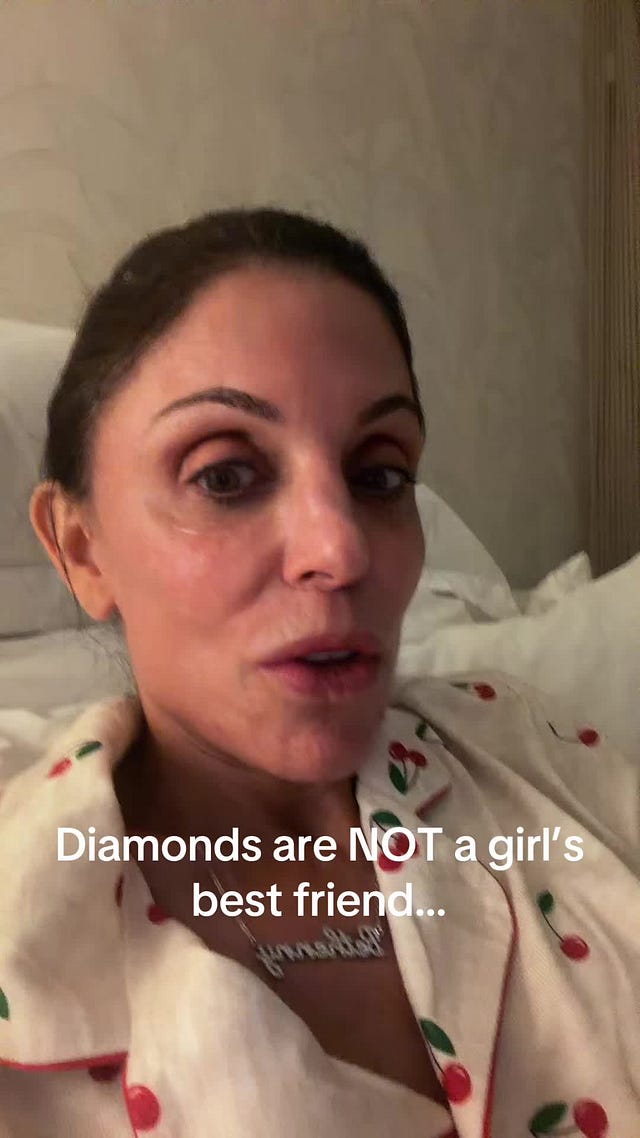
I was doom-scrolling, like everyone else, when I landed on Bethenny Frankel’s lab-grown diamond video. According to her, “you have to be a moron to buy a diamond right now,” and “the whole diamond world has been fucked sideways.” Aside from the tone and choice of words, she’s not entirely wrong. But the line that actually made me stop scrolling wasn’t either of those. It was when she said diamonds don’t have value anymore, they’re not rare anymore, and you might as well buy a cubic zirconia.
The internet didn’t ruin diamonds. A manufacturing process did that, slowly, over a decade, mostly in trade publications nobody outside the industry reads. The internet simply disrupted the system around it by removing the gatekeepers.
It used to take a loupe and an appointment to get anyone in this industry to tell you what your stone was actually worth. The internet took a category that had long been guarded by discretion, institutional knowledge and, yes, a certain amount of intimidation, and opened it up to everyone. The democratization of information has also democratized authority.
Consumers have access to more information than they ever have, and I think that’s fantastic. We should celebrate the fact that people are suddenly fascinated by diamonds while simultaneously questioning who’s doing the teaching. The trouble is that the internet didn’t replace the gatekeepers with better ones. It made everyone capable of sounding like one.
Bethenny is a pretty good example of what that looks like in practice. She has, among other things, a series called Jewelry University. And I couldn’t help but think of Kanye’s famously blunt question about Lady Gaga becoming Polaroid’s creative director: “What the fuck does she know about cameras?”
It’s a useful question here too: what makes someone qualified to teach you about diamonds?
 Tiktok failed to load.
Enable 3rd party cookies or use another browser
And I think the answer has gotten harder to identify because people don’t always decide who to trust based on who knows the most. They decide based on who sounds the most certain, and certainty shows up in a few different disguises. Sometimes it’s confidence. Sometimes it’s fluency. On a subject like this one, it’s often morality.
Diamonds are an especially easy place for that last version to take over, because the industry is so widely misunderstood and so easy to frame as a moral question instead of a factual one. Defending lab-grown diamonds can feel like the correct position before anyone’s actually looked at the argument, simply because it reads as more ethical, more modern, less complicit in whatever the natural diamond industry gets accused of. And once a position feels virtuous, it stops needing to be checked. The certainty comes from the framing, not from the facts underneath it.
To be clear, none of Bethenny’s specific claims that I've seen were actually moral arguments. But she’s operating inside a field where that consensus already exists, where “lab-grown” reads as the default good guy before anyone’s said a word about carats or clarity. That consensus is exactly what hands someone with a strong opinion and total confidence (Bethenny included) the amplification to speak on things they’re not necessarily equipped to speak on. It also hands the natural diamond loyalists a comment section to do what comment sections do best: argue, moralize, dunk. Neither side ends up learning anything though. They’re just restaging the same fight the algorithm already knows how to serve.
That’s also where incentive gets weaponized instead of examined. An industry professional defending lab-grown diamonds gets dismissed because they’re selling something. Someone defending natural diamonds gets dismissed for exactly the same reason. Nobody’s incentive gets scrutinized consistently, just whichever one is inconvenient to the point being made. The agenda becomes the story before the substance does.
Bethenny is interesting in that context because she also curates and sells lab-grown diamond jewelry, through her own site and brand partnerships. That doesn’t automatically make her argument wrong, but it does make the certainty of it worth examining.
The bigger issue is that most people aren’t going to spend twenty hours researching diamond pricing, geology, manufacturing, supply chains and market history before deciding what they think. They shouldn’t have to. That’s what good education is supposed to do. Take the certainty out of the hands of whoever delivers it best, and put it back on the facts.
And right now, I’m not sure the industry has created enough of a trusted middle ground: people who can make diamonds engaging, explain what’s actually happening, and give consumers enough context to form an opinion without immediately asking them to buy something or choose a side.
The QVC of it all.
There’s a version of this piece where TikTok Shop diamond auctions are a moral collapse — luxury commerce eating itself, people getting finessed live on camera. I don’t think that’s what’s most revealing.
The real comparison is QVC. Diamonique built an empire on a charismatic host, a countdown clock, and a “you don’t want to miss this one” energy that turns jewelry into event television. TikTok livestreams are basically that with an algorithm instead of a channel guide.
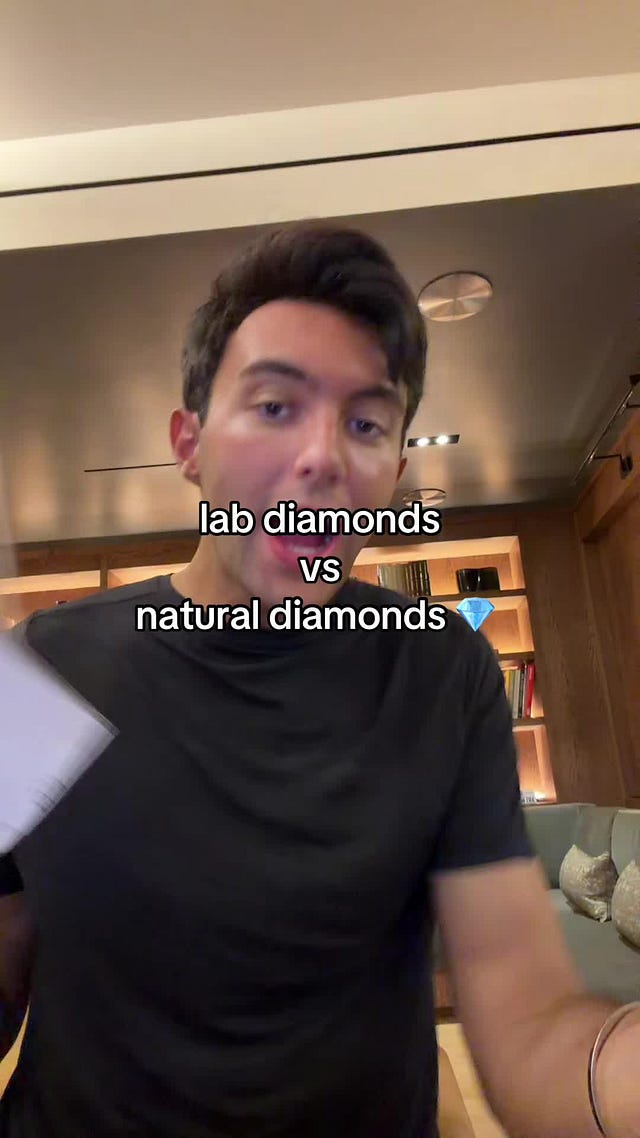
Rolling Stone went looking for the people fueling the trend and found buyers treating these auctions almost like a hobby, including Ryan Roth, who won his first lab-grown diamond for $700, then bought another for $94 while scrolling in the back of an Uber. His justification was simple, “I have adult money and free will.” None of this is particularly new. It’s impulse shopping, the same species QVC has been monetizing since the ‘80s.
 Tiktok failed to load.
Enable 3rd party cookies or use another browser
But watch enough of his content and you can see the whole arc happen inside a single video. In one clip, Roth walks through his TikTok Shop loose gem hauls and then, without much of a pause, pivots straight into commentary: lab-grown and natural diamonds are chemically identical, natural diamonds are about to lose real value now that lab-grown has gone mainstream. Somewhere in the middle of that, he mentions that his family were, in his words, real old-school New York jewelers, and that his grandfather was the honorary mayor of 47th Street. Then comes the line: “That’s why I’m qualified to speak on diamonds.” Buyer, narrator, and authority, inside about ninety seconds, with an unverifiable family title doing the work a credential usually would.
Interestingly, Ryan Roth and Bethenny Frankel have even crossed paths on TikTok over their shared interest in diamonds, creating a rather fascinating dynamic to watch as the subject moves further into mainstream internet culture.
Some of the claims being made around these diamonds aren’t just opinions about whether you should buy one. They’re claims about what diamonds are, what they’re worth, and what makes them valuable in the first place.
Where the rarity argument falls apart.
To be fair, this isn’t really a Bethenny or Ryan problem. Some version of “diamonds aren’t rare anymore, they’re basically worthless” shows up every time lab-grown pricing makes headlines. Roth makes his own version of it in that same clip, just a few sentences after explaining why he’s qualified to say it. Their dynamic is just catching my eye and getting me thinking about what it says about who we’re willing to trust when it comes to diamonds.
The underlying claim isn’t crazy, either. Wholesale costs for lab-grown stones have been falling sharply, and resale is genuinely bad too. People should also just buy whatever they want. No notes there.
Where it breaks is the jump from “lab-grown prices collapsed” to “diamonds have no value” to “just get a CZ.” Three different claims compressed into one.
And that’s exactly why this matters. Diamonds are complicated enough that most consumers can’t always tell when something’s being oversimplified.
When people say “diamonds don’t have value anymore,” they’re usually not talking about every diamond equally. They’re talking about the position natural diamonds have historically occupied (culturally, financially, emotionally) and using the falling price of lab-grown diamonds as evidence that the entire category has somehow lost its value.
Rarity does drive value, but it’s never been the only input. Price, sentimental value, material value and investment potential are different things, and the diamond market is subject to many of the same forces as any other market: supply, demand, production costs, positioning and consumer expectations. Two stones with identical 4Cs can still command different prices when certification, provenance, brand, craftsmanship, seller and venue all enter the equation.
A diamond can be a bad investment and still be valuable to the person wearing it. A natural diamond can be rare without being a good financial investment. A lab-grown diamond can be chemically identical to a natural diamond and still behave completely differently in the marketplace.
And here’s what sits at the center of the whole moment for me: lab-grown diamonds getting cheap and abundant doesn’t make natural diamonds any less rare. Natural diamonds still form under conditions that take place over geological time, deep in the earth. That part of the equation hasn’t budged because a factory somewhere figured out how to grow a matching stone in a few weeks.
What changed is the economics of diamond as a manufactured product, which is a totally different story. Production has scaled dramatically over the last decade, and costs have fallen the way costs fall for anything you can produce at scale. Abundance, production costs, consumer demand, positioning, distribution and expectations all affect what a product can command. Scarcity is just one variable.
And the CZ line genuinely bugs me, because it flattens two different materials into one sentence. Cubic zirconia is a simulant, meaning it’s a different substance that just looks similar to a diamond. A lab-grown diamond is synthetic, meaning it’s chemically and physically an actual diamond, grown instead of mined.
This is also where I understand some of the industry’s obsession with terminology, even when I don’t always agree with how it handles it. Consumers routinely use “fake,” “lab-grown,” and “CZ” as if they’re interchangeable. They’re not. If the goal is consumer confidence, the answer can’t just be policing vocabulary. It has to be education, and that’s an area where the industry has plenty of room to do better.
So who actually gets to talk about diamonds?
This is where I keep circling back to: what actually makes someone qualified to talk about diamonds?
I don’t think the answer is simply a credential, a job title, a family connection, or a large following. And I certainly don’t think having an opinion should disqualify anyone from participating in the conversation. Diamonds get more riveting when more people care about them.
What I do think matters is the difference between knowing something and sounding like you know something. Between having a perspective and presenting it as fact. Between educating someone and giving them a conclusion.
I’ve spent enough years behind the jewelry counter to know that expertise isn’t memorizing the 4Cs. It’s knowing what you don’t know, what questions to ask, and how much context someone needs before you give them an answer.
That’s what I think gets lost online. We have more information, more opinions and more people talking about diamonds than ever before, but somehow less clarity around who we should actually be listening to.
A diamond doesn’t need fewer opinions. We just need to get better at knowing which ones are worth listening to.
The industry is really lacking a good spokesperson who can talk about diamonds knowledgeably. Unfortunately, whoever is the loudest gets seen more, and suddenly theyre an "expert". It's also difficult because diamonds seem to be tied so much to peoples' emotions and values, and so once they hear something they align with, it's hard to point out misinformation.
Congrats on getting this article on the Jewelry Wire!